
Where Range Actually Comes From
An RF product has two antennas: one in the transmitter, one in the receiver. Both are matched to the board layout by component values chosen during design, and both are affected by what surrounds them. In a plastic housing, the plastic is part of the antenna system — which means the housing material, the wall thickness and the position of the battery all change the radiation pattern.
Matching, and Why It Is Invisible
| Concept | What it means | Consequence | Note |
|---|---|---|---|
| Match | The component values that present the antenna to the board at the design frequency | How much of the output power is actually radiated | Designed once, per band |
| Detuning | Anything that changes the antenna environment after design | The loss of match in the finished product | The battery, the button and the plastic all do it |
| Efficiency | Radiated power as a fraction of conducted power | The real-world range consequence | Varies by band and by housing |
| Keep-out | The space the board designer must keep clear around the antenna | Whether the layout is even possible | A layout decision made on day one |
What Changes Range in the Field
| Factor | Effect | Who controls it |
|---|---|---|
| Battery position | A battery close to the antenna detunes it | The designer |
| Housing material | Lossy plastic absorbs energy; metal blocks it entirely | The designer |
| Button proximity | A metal button or a metal dome shield changes the pattern | The designer |
| Body contact | A hand on the housing absorbs and detunes | The user |
| Interference | LED drivers, motor inverters, and other RF emitters | The site |
| Receiver position | A receiver inside a steel cabinet loses most of the range | The installer |
How Range Should Actually Be Tested
Test it where it will be used, in the worst case: door partially open, worst weather, end of battery life, and the antenna in the orientation the customer will actually hold it. A specification measured on a bench with a calibrated analyser, in free space, with a fresh battery, tells you the product is compliant. It does not tell you it will work in a car park.
A range figure quoted without the antenna, the frequency and the test geometry is not a specification. It is a number.
The Practical Take for a Buyer
When a remote in your range has an unexplained intermittent range complaint, check the four things the designer controlled before you check the customer’s site: battery position, housing material, button construction and antenna keep-out. A high share of these complaints trace to a housing change that was made for cost reasons and never re-validated for RF.
Request a Quotation — Antenna Matching and Range
Send the band, the code system and the quantity you need. We reply with the exact part number, EXW price, MOQ and lead time. MOQ 100 pcs per SKU.
Send Inquiry on WhatsAppEmail: Joanna@rfmando.com · MOQ 100 pcs per SKU · 1 free sample per SKU ($30 DHL, buyer pays) · Lead time 7-15 days · T/T 30/70 · EXW Xiamen
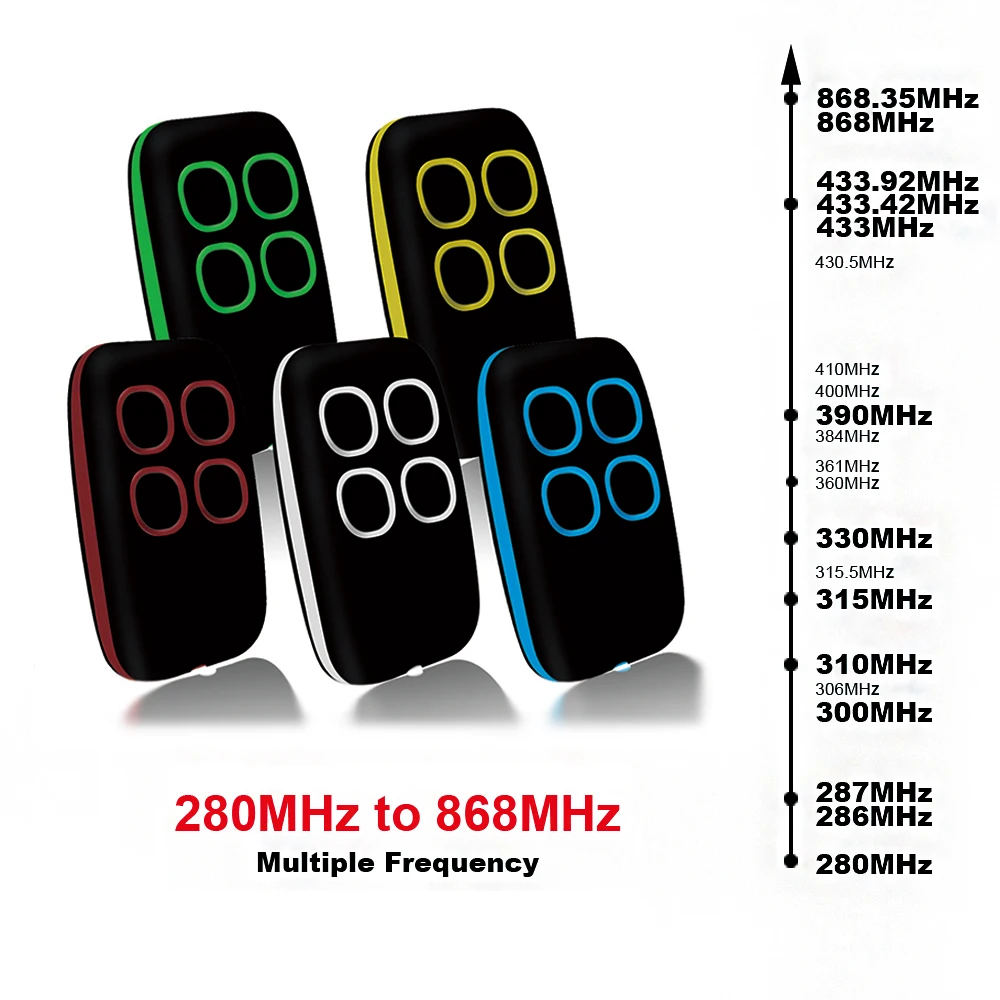
Catalogue references for the specification above: 280-868MHz multi-frequency garage remote duplicator and HORMANN 868MHz rolling-code garage door remote. All are MOQ 100 pcs per SKU, with a 7-15 day lead time and one free sample per SKU ($30 DHL, buyer pays). They are supplied on our own PCBA and housing tooling.
Where to Order
Terms
MOQ 100 pcs per SKU. One free sample per SKU ($30 DHL, buyer pays). Lead time 7-15 days. Payment T/T 30/70. Prices EXW Xiamen. 100% functional test on every unit; a third-party QC report at AQL 5% is available on request. CE-RED, RoHS and FCC Part 15 documentation; RCM available.